The digitization of municipal wastewater systems is no longer a secondary concern for local governments. Between regulatory complexity, tight deadlines, a growing number of user requests, and the need to ensure the reliability of often-scattered data, technical departments must now do more, faster, and to an ever-higher standard. This is particularly true in densely populated urban areas, where the challenges of connection, by compliance, by PFAC management, by billing and coordination with the system's other tools on a daily basis.
The case study presented during this webinar demonstrates howthe EPT Boucle Nord de Seine—a district within the Greater Paris Metropolis created in 2016, comprising seven municipalities between northern Hauts-de-Seine and Argenteuil in Val-d’Oise—has organized its water and wastewater management division around a customized tool, co-developed with DAMAaaS. The territory covers a catchment area of over 460,000 residents, which immediately highlights the scale of the operational challenges.
Animée par Agathe Bault, la webconférence a réuni Marie Moulin, ingénieure d’affaires NoCode chez DAMAaaS, Sylvie Tain Directrice générale des services techniques pour l’EPT Boucle Nord de Seine, ainsi que Jacques Chicoisne Directeur performance et Transformation numérique, également représentant du territoire. Leur échange n’avait rien d’un discours théorique : il s’agissait d’un vrai retour d’expérience, avec démonstration, chiffres d’usage et enseignements directement transposables à d’autres collectivités en France.
Why scattered tools continue to hinder the management of sanitation projects
A profession that is becoming increasingly demanding, fragmented, and high-risk
The starting point is simple: public water and wastewater services must manage a wide range of tasks, often over long cycles, using information from various sources. The webinar clearly highlights this reality on the ground: scattered data, scattered tools, difficulties in tracking progress over time, and increasing regulatory and operational requirements. In other words, the real challenge is not just “digitization,” but structuring processes, ensuring the reliability of information, and making teams’ day-to-day work easier.
In Boucle Nord de Seine, this pressure has become very real. The Water and Sanitation Department, which was formally established in 2022, now has just under ten employees. Yet, despite this lean structure, it must handle an already substantial workload: for the year 2025 alone, the region anticipates more than 500 permits or prior notifications, approximately 300 service requests annually, and nearly 150 requests for new connections. This level of workload quickly renders general-purpose or makeshift tools inadequate.
- more than 500 permits or prior notifications in 2025;
- approximately 300 requests for assistance per year;
- nearly 150 requests for new connections.
When Excel Reaches Its Limits
As in many local governments, the initial approach was pragmatic: start with an Excel spreadsheet to centralize actions, resident requests, construction projects, and service calls. The problem was that after a few years, the spreadsheet became too cumbersome, hard to read, difficult to use collaboratively, and, above all, unable to generate useful cross-references—particularly from a geographic perspective. An example cited during the webinar perfectly illustrates this limitation: identifying that the same street has already been the subject of four service requests in a single month is not straightforward in a spreadsheet, even though this is essential information for managing operations.
Added to this is another common challenge in technical departments: Word “templates” that are filled out on a case-by-case basis, resulting in variations, omissions, and administrative work that can sometimes be tedious. The need, therefore, was not simply for “yet another software program,” but for a business application capable of automating, standardizing, and linking data to the department’s actual operations.
La solution choisie par l’EPT Boucle Nord de Seine : une approche NoCode collectivités, sur mesure et évolutive
Pourquoi le NoCode a fait sens dans ce contexte
The decision to DAMAaaS made in a specific context. Jacques Chicoisne explains that he initially looked for an existing solution in the wastewater treatment market, but that there was no real “off-the-shelf” product that adequately met the region’s needs. This is a common observation in the public sector: organizations, information flows, service level agreements, local customs, and regulatory constraints differ too much for a standard tool to be a perfect fit.
L’intérêt du NoCode collectivités, tel qu’il est présenté dans ce retour d’expérience, est précisément là : partir du métier réel et construire l’outil autour de lui. Marie Moulin rappelle que l’approche DAMAaaS repose sur la co-construction entre les équipes métier, la DSI et l’éditeur, avec des briques déjà existantes qui permettent de composer une base de données, un workflow, et des interfaces sans développement spécifique lourd à chaque étape. La promesse n’est pas seulement la rapidité, mais aussi la capacité à adapter l’application aux évolutions du terrain.
A guided collaborative effort, not a drift toward “shadow IT”
The strength of this project lies not only in technology but also in its organizational structure. The region emphasizes the central role of business units in defining requirements, through an iterative approach, workshops, regular adjustments, and a process of continuous co-creation. DAMAaaS , for its part, DAMAaaS the need for clear oversight by the IT department, including granular access rights management, usage tracking, application governance, GDPR compliance, and secure hosting. The platform is presented as GDPR-compliant by design, featuring encryption, regular security audits, and a native access rights matrix.
C’est un point important pour convaincre les décideurs publics : ici, le NoCode n’est pas présenté comme une solution “hors cadre”, mais comme un levier pour accélérer l’innovation métier tout en restant compatible avec les exigences de sécurité, de gouvernance et de traçabilité attendues dans le secteur public.
Use Cases: How the Digital Transformation of Public Sewer Systems Is Taking Shape in Operations
1. Planning applications: standardizing decisions and reducing the administrative burden
The first module to be fully implemented concerns planning applications. This is a highly illustrative use case, as it combines regulatory review, technical checks, document generation, and an approval workflow. The system allows users to enter or retrieve case data, structure the necessary fields, generate a standardized decision, and then have it approved through the designated workflow. The benefit is twofold: the administrative process becomes faster, and, most importantly, the department ensures that all notices produced adhere to the same standard.
The demonstration also highlights a more strategic benefit: the report is not a standalone document. It is linked to the parcel, the file, network data, and, ultimately, the other components of the system. This is where the digitization of public sewer systems takes on a whole new dimension: we are no longer just producing a document; we are building a usable territorial database.
2. Mapping and “parcel-level” logic: linking structures, networks, and historical data
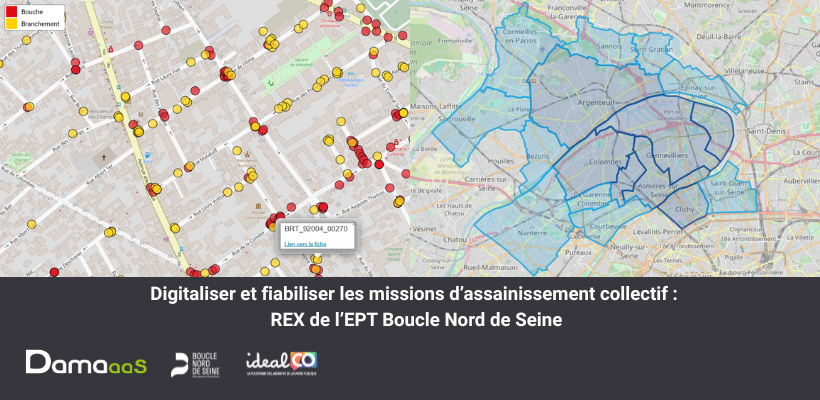
One of the modules developed for Boucle Nord de Seine focuses on map views of infrastructure, manholes, and the sewer system. The department explains that it was essential to link operational data to the geography of the area in order to cross-reference incidents, requests, and network characteristics.
In this context, the “parcel-level” view becomes a key feature. When an agent clicks on an address or a parcel, they can access permit notices, connection requests, and even the history of a blockage or service call. This contextual centralization is a major benefit for mission management: it eliminates the need to search for information across multiple tools, files, or people.
3. Compliance and Relations with Notaries: Improving the User Experience
Another application already in use: managing compliance requests related to real estate sales. To assist notaries who need a certificate of compliance, a form has been added to the local government’s website. Applicants can enter a few details and automatically receive a response by email. The result: fewer calls to the switchboard, faster service for professionals, and greater user satisfaction.
Digitalization isn’t just about internal operations; it also transforms the quality of service visible to the public. For a local government, this is a strong selling point. A simple interface, an intuitive form, and an immediate response create a much smoother experience than handling requests over the phone or on paper.
4. Connections, service calls, PFAC management, and billing: toward a seamless monitoring process
The scope will be expanded to include other key use cases: connection tracking, PFAC management, billing, access control based on user profiles, and work order tracking. This is precisely the value of a platform for creating custom business applications: it doesn’t stop at a single module, but builds a cohesive environment around the department’s actual processes.
Results and benefits observed
Already significant volumes
Feedback is not merely theoretical. Boucle Nord de Seine is already reporting usage figures: since September 1, 2025, the region has processed approximately 300 planning applications, nearly 900 compliance requests, and created 6,000 geolocation points in the database, notably thanks to the integration of data from the sewerage master plan. These figures show that the tool is not a prototype: it is gradually becoming the department’s operational reference system.
- 300 planning applications processed;
- nearly 900 compliance requests;
- 6,000 geolocation points have been added to the database.
Tangible benefits for the teams
The first benefit is improved reliability. Reviews are standardized, required fields are predefined, data entry errors are reduced, and critical information remains linked to the correct file. The second benefit is centralization: data, documents, history, and tracking are all in a single environment, rather than scattered across Excel, Word, emails, and third-party tools. The third benefit is transparency: teams can better monitor activity, identify recurring issues, document cases, and make decisions based on a more solid foundation.
The REX also stands out for its user-friendliness. The department explains that users are more likely to embrace the tool because they helped build it. This approach is essential in local governments’ digital transformation projects: rather than imposing off-the-shelf software on teams and expecting them to adapt, we work with them to build a tool that fits their workflows and can evolve alongside them.
What other local governments can learn from this feedback
Le premier enseignement est qu’il faut partir d’une analyse métier sérieuse. Jacques Chicoisne insiste sur ce point : sans cadrage clair, sans travail sur les flux, sans clarification des besoins, même une bonne technologie ne suffit pas. Le deuxième enseignement est que l’implication des équipes opérationnelles est fondamentale : elle conditionne l’adoption. Le troisième est que le NoCode peut aller vite, mais qu’il reste une démarche exigeante, encadrée et progressive. DAMAaaS parle d’applications conçues en quelques jours à quelques semaines selon leur complexité, mais le projet Boucle Nord de Seine montre aussi que les intégrations, les API et les besoins spécifiques peuvent étendre la durée réelle d’un projet complet.
Enfin, ce REX montre qu’une collectivité n’a pas besoin d’attendre un “grand projet SI” pour améliorer son fonctionnement. Sur des métiers comme l’assainissement, où les besoins sont précis et fortement ancrés dans le terrain, une approche incrémentale, bien gouvernée et orientée usage peut produire très vite de la valeur. C’est précisément ce qui rend le NoCode collectivités crédible aujourd’hui dans les services techniques environnementaux.
FAQ: Digitalization of Public Sewer Systems
Why digitize municipal wastewater management operations?
Digitization makes it possible to centralize data, ensure the reliability of processes, standardize notifications, track cases more effectively, and improve the quality of service provided to both users and external partners, particularly notaries and other involved companies.
What are the main obstacles faced by sanitation services?
The most common obstacles include scattered data, a lack of standardization among tools, difficulty linking information to specific plots, the administrative burden associated with paperwork, and a lack of overall visibility into requests, interventions, connections, or certificates of compliance.
Quel est l’intérêt d’une approche NoCode pour une collectivité ?
Une approche NoCode permet de construire une application métier adaptée aux besoins réels du terrain, sans dépendre d’un produit standard mal aligné avec l’organisation locale. Elle facilite aussi l’évolution progressive de l’outil, dans un cadre gouverné par la DSI et compatible avec les exigences de sécurité et de conformité.
What concrete benefits have emerged from the feedback provided by the EPT Boucle Nord de Seine?
The region highlights the standardization of notifications, the centralization of data, improved monitoring at the plot level, a reduction in unnecessary requests, greater transparency in operations, and easier adoption through collaborative development with business teams.
Conclusion
Digitalization in the public sewerage sector is not just about tools. It is about service continuity, data reliability, a comfortable working environment for staff, and the quality of service provided to users. Feedback fromthe EPT Boucle Nord de Seine in Hauts-de-Seine shows that a local authority can fundamentally transform how it manages its operations without resorting to a rigid project or oversized software. By relying on a collaborative approach, an adaptable platform, and clear governance, the region has begun to integrate urban planning, compliance, mapping, utility connections, and user relations into a single environment.
For public policymakers, the message is clear: when data is no longer scattered and processes become transparent, the public water and wastewater sector gains in efficiency, traceability, and the ability to anticipate future needs. And this is precisely what local governments are seeking today as they strive to combine operational performance, organizational efficiency, and sustainable modernization.