
When we talk about the digitization of government agencies, the primary concern is that they will become completely devoid of humanity. Yet that is certainly not what users are looking for. In fact, while they want things to be flexible and fast, they still expect to find staff on-site to address their needs. But does the government have to become a robot to be more efficient?
What is a robot?
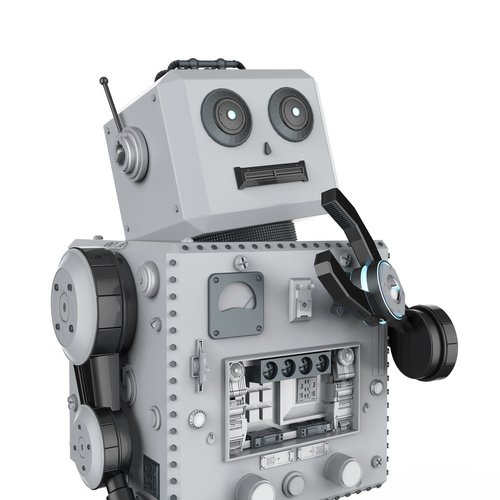 By definition, according to Larousse, a robot is an automatic device capable of manipulating objects or performing tasks according to a fixed, modifiable, or adaptable program. Not to be confused with an automaton, a robot is autonomous and capable of analyzing its environment. However, there is no evidence that it is currently capable of thinking.
They are used in various forms within organizations: chatbots, industrial robots, self-driving cars, artificial intelligence… They thus perform many tasks that were previously carried out by humans. These are often physically demanding, repetitive, and unrewarding jobs.
What do the French expect from the digitization of government services?
This automation or robotization of daily life is becoming widespread in government agencies through e-government. This is causing concern among users, who fear they will have to deal only with robots when handling their sometimes complicated administrative tasks. The proof: for 80% of French people, the digitization of public services has led to a form of dehumanization*. Nearly half of those surveyed say that online procedures remain complicated and that they prefer to visit in person to access certain public services, such as city hall or the civil registry.
Paradoxically, they want more notifications about the steps they need to take and more pre-filled forms tailored to their personal circumstances. Above all, they want procedures to be simplified, waiting times for documents or information to be reduced, and for staff to be able to provide them with information efficiently.
4 Reasons Why DAMAaaS a Robot
The DAMAaaS solution automates certain tasks related to administrative procedures, the digitization and submission of supporting documents, and the validation of processes through electronic signatures… But it’s not a robot! Here are four reasons why.
DAMAaaS organizations establish a structured framework
 Implementing a process automation system requires government agencies to reevaluate their work methods. In many cases, it is necessary to redesign them, evolve them, and adapt them to a new organizational structure. Beyond just a tool, It is an exoskeleton that enables employees to carry out their tasks. However, for this to work, the processes must be clearly defined. And to achieve that, it is up to the employees to work on defining them; the tool cannot do it for them.
DAMAaaS people at the heart of the process
DAMAaaS a software solution that cannot function without human intervention. Employees fill out forms, assign tasks, set up alerts, and more. The tool, once programmed, then automatically triggers these actions. However, the employee remains in control of these processes: they design and configure them. DAMAaaS an additional tool to help them do their job and maximize their value.
DAMAaaS not replace employees
DAMAaaS simplify and streamline processes. However, it does not replace the work of an employee. It simply eliminates low-value-added tasks such as re-entering information. It also saves time by simplifying procedures (for example, electronic signatures eliminate the need to wait for a manager to be present to place an order; the manager can do so remotely in a matter of seconds) and through the implementation of automatic reminders.
DAMAaaS operational intelligence
With the proliferation of data, information systems are becoming increasingly complex and interconnected. Teams now have access to numerous metrics to help them make the right decisions. However, they still need the tools to manage their operations. That is precisely the mission of DAMAaaS to empower business units to model their processes, monitor their operations, and receive alerts in the event of delays—all in a simple and agile way.
As you can see, the public sector of the future cannot exist without people. However, it will have more tools at its disposal to support staff and users, thereby improving the services provided. Would you like to learn more? Please feel free to contact us.
*According to a Mazars study conducted by Opinion Way